FTA announces Corporate Tax Registration Deadline - 90 days from Date of Incorporation/MOA. AED 10k penalty for late registration

UAE E-Invoicing Mandate 2026: What Changes for Your Business and When

If you invoice anyone in the UAE — another business, a government entity, or a related company — the way you issue that invoice is about to change. Starting July 2026, the UAE is rolling out mandatory electronic invoicing (e-invoicing) in phases, and by mid-2027 it will apply to almost every VAT-registered business in the country.
This isn’t the same as emailing a PDF invoice or generating one from your accounting software. It’s a structured-data system that connects your invoicing directly to the Federal Tax Authority (FTA) through approved third-party providers. Here’s what’s actually changing, when it affects you, and what to do about it now.
What is UAE e-invoicing, exactly?
Under the new system, invoices aren’t just documents — they’re structured data records in a format called PINT AE (Peppol International Invoice – UAE), built on the international Peppol network. A compliant tax invoice carries around 51 mandatory data fields; a commercial invoice carries 49. This data has to be generated by your accounting or invoicing system, validated, and transmitted electronically — it can’t simply be typed into a PDF template and emailed.
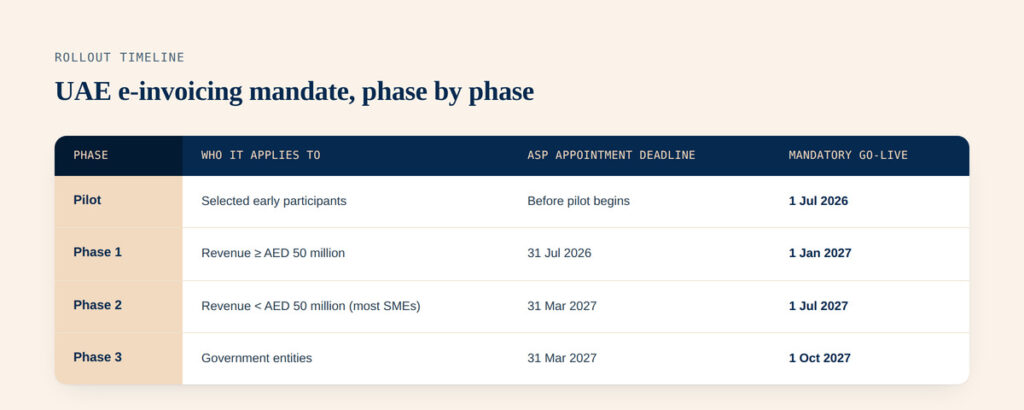
That transmission happens through the 5-corner model:
- Corner 1 — your business (the seller) issues the invoice
- Corner 2 — your Accredited Service Provider (ASP) validates and formats it
- Corner 3 — the buyer’s ASP receives it
- Corner 4 — the buyer’s system receives the validated invoice
- Corner 5 — the FTA receives reporting data on the transaction
Who does this apply to?
The mandate is broader than VAT alone. It applies to businesses conducting transactions in the UAE regardless of VAT registration status, and covers business-to-business (B2B) and business-to-government (B2G) invoices, including transactions between related companies in the same group.
The rollout timeline
The mandate is being introduced in phases rather than all at once, based on business size.
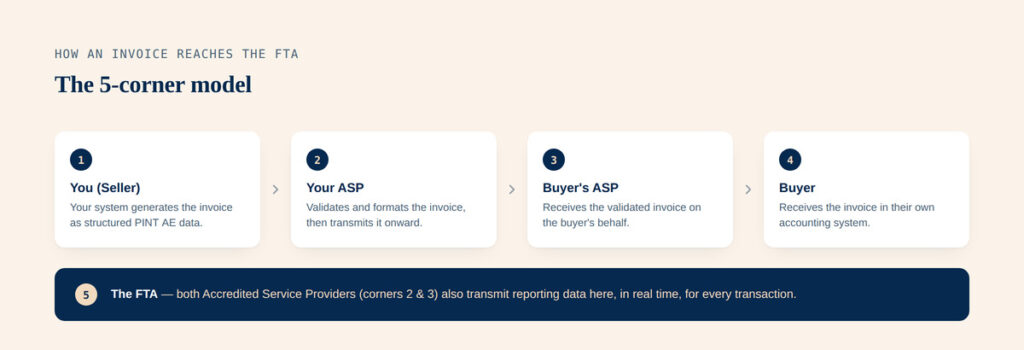
In short: the pilot starts 1 July 2026 for selected early participants; Phase 1 (revenue ≥ AED 50 million) needs an ASP appointed by 31 July 2026 and is mandatory from 1 January 2027; Phase 2 (revenue under AED 50 million — most SMEs) needs an ASP by 31 March 2027 and is mandatory from 1 July 2027; Phase 3 (government entities) shares the same ASP deadline as Phase 2 but goes mandatory 1 October 2027.
For most small and mid-sized businesses in Dubai, that means the real deadline to have this sorted is mid-2027 — but the ASP appointment window (31 March 2027) comes earlier than most people expect, and system changes typically take longer than businesses budget for.
What you need to do before your deadline
1. Get a Tax Identification Number (TIN), if your business doesn’t already have one on file with the relevant authority.
2. Choose an Accredited Service Provider. This is the single most consequential decision in the process — your ASP needs to integrate with whatever accounting or ERP system you’re already running (or you may need to upgrade it). Look for a provider with a demonstrated implementation track record and strong data security controls, not just the cheapest quote.
3. Map your invoicing data. Sit down with your accountant and go through what fields your current invoices are — and aren’t — capturing. Missing customer tax registration numbers, inconsistent product/service codes, or manual invoice numbering are the most common gaps that surface at this stage.
4. Test before you’re forced to. Businesses that treat the pilot and early phases as a dry run — even if their own mandatory date is 12+ months out — tend to have a far smoother go-live than those that wait.
5. Budget for the transition. ASP fees, potential accounting software upgrades, and staff time for data cleanup should all be factored into your 2027 planning now, not after your deadline is confirmed.
Why this matters even if your deadline feels far away
Two things make this different from past compliance changes. First, ERP and accounting system changes take months, not weeks — vendors and ASPs are going to get busier as the SME deadline approaches, so businesses that start early get better terms and more attention. Second, non-compliant invoices may not be accepted by counterparties who are already on the system, which can create cash-flow friction with larger customers or government contracts well before your own mandatory date arrives.
E-invoicing isn’t optional, and it isn’t just an IT project — it touches how your business records revenue, how quickly you can invoice, and how your accounting data flows into your VAT and corporate tax filings. The businesses that come out ahead will be the ones that treat 2026 as the preparation year, not 2027.
If you’re not sure which phase applies to you, or want a straight answer on what your current accounting setup is missing, Balance Brite’s VAT and accounting team can walk through your invoicing workflow and flag the gaps before they become a deadline problem.

Balance Brite delivers reliable tax, VAT, corporate, and business advisory solutions to help businesses stay compliant, reduce risks, and grow with confidence.
Quick Links
Newsletter Signup
Subscribe for newsletter & get day news, service updates