FTA announces Corporate Tax Registration Deadline - 90 days from Date of Incorporation/MOA. AED 10k penalty for late registration

Mainland vs Free Zone vs Offshore: Choosing the Right UAE Company Structure

Every business setup conversation in the UAE eventually comes down to this question: mainland, free zone, or offshore? All three let you own 100% of your company. All three are legitimate, well-established structures. But they’re built for different purposes, and picking the wrong one is one of the most common — and most expensive — mistakes new business owners make in Dubai.
Here’s how they actually compare, and how to think about which one fits your business
- Mainland: Trade anywhere in the UAE and internationally, no restrictions on who you invoice. Needs a physical office.
- Free zone: 100% foreign ownership guaranteed, often lower setup cost, but can’t directly invoice UAE mainland clients without extra steps.
- Offshore: Can’t trade or operate inside the UAE at all — used for holding assets, shares, or intellectual property, not for running an operating business.
Where you can actually do business
This is the distinction that trips people up most.
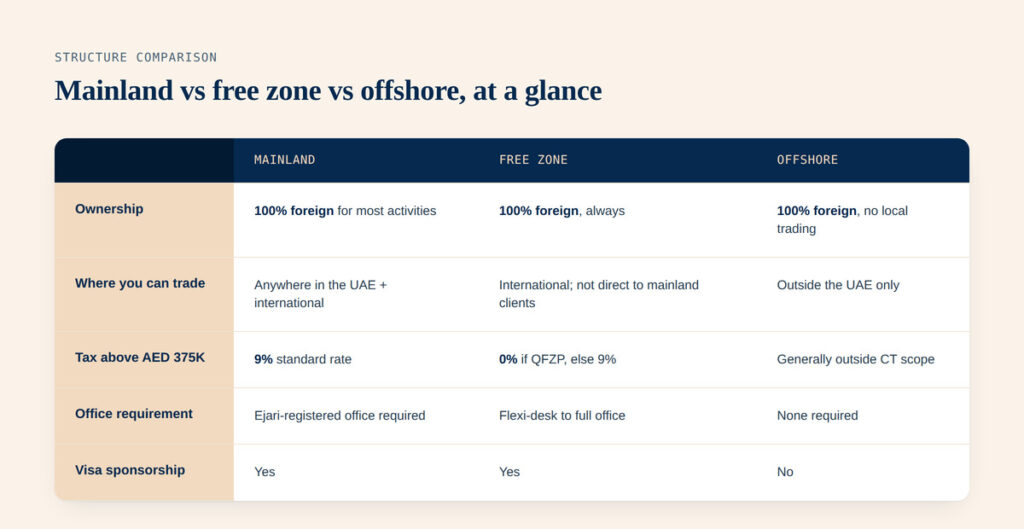
A mainland company can trade anywhere in the UAE and internationally, with no restriction on which customers it serves. If you want to sell to UAE government entities, walk-in retail customers, or mainland corporates without any workarounds, mainland is built for that.
A free zone company is restricted from directly invoicing UAE mainland clients. In practice, a free zone company either needs a dual licence or has to route mainland sales through a mainland distributor. If your customers are mostly international, or other free zone companies, this restriction rarely matters. If your customers are mainland UAE businesses or consumers, it can become a real operational headache.
An offshore company cannot trade inside the UAE at all. It’s limited to holding assets, intellectual property, or shares in other companies — not issuing invoices for goods or services delivered in the UAE.
Tax treatment
Mainland companies pay 0% corporate tax on the first AED 375,000 of taxable income, and 9% on taxable income above that threshold — the standard UAE corporate tax structure.
Free zone companies only get access to the 0% rate on qualifying income if they meet the full set of Qualifying Free Zone Person (QFZP) conditions — a specific test around the nature of your income and activities. If you don’t meet those conditions, the standard 9% rate applies to income above AED 375,000, the same as mainland. In other words: “free zone” does not automatically mean “0% tax” — that’s a common and costly misunderstanding.
Offshore companies generally fall outside the scope of UAE corporate tax altogether, since they aren’t licensed to generate trading income in the UAE.
Office requirements
Mainland companies need a registered office under an Ejari tenancy contract — you can’t operate indefinitely from a flexi-desk or virtual address.
Free zone companies typically have more flexibility, with flexi-desk, shared office, or full office packages depending on the specific free zone and licence type.
Offshore companies have no UAE office requirement at all.
Visa sponsorship
Both mainland and free zone companies can sponsor UAE residency visas, with the number of visas tied to your office size or package type. Offshore companies cannot sponsor visas, since they’re not licensed to operate or employ staff in the UAE.
Typical setup cost (2026)
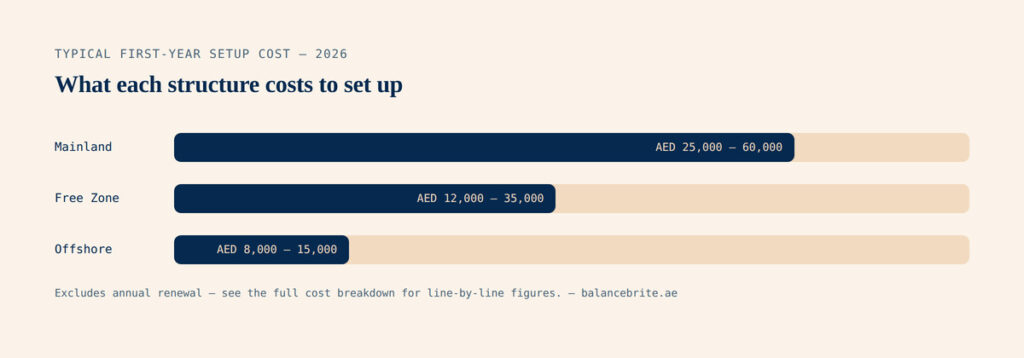
As a general first-year range: mainland setups typically run AED 25,000–60,000, free zone setups AED 12,000–35,000, and offshore setups AED 8,000–15,000 — though the actual figure depends heavily on your activity, visa count, and office choice. (For a full breakdown, see our companion guide on the true cost of setting up a business in Dubai.)
Which structure actually fits your business?
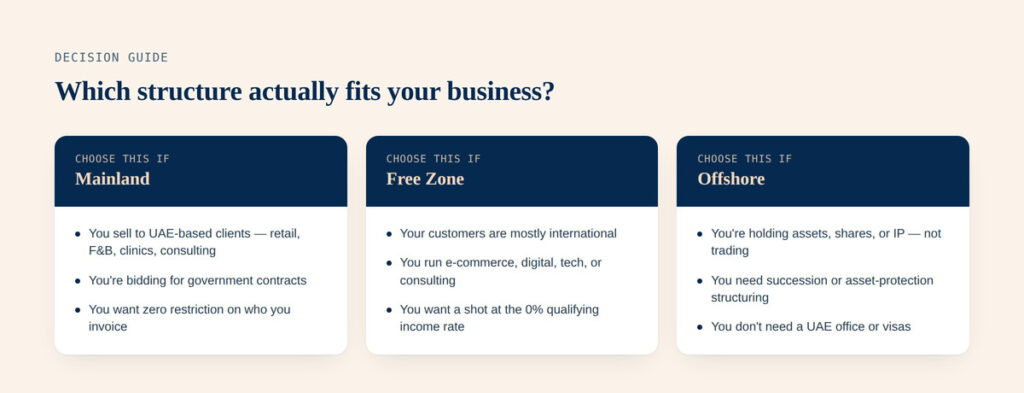
Choose mainland if: you’re selling to UAE-based customers (retail, F&E, clinics, consulting for local clients), bidding for government contracts, or want zero restrictions on who you can invoice.
Choose a free zone if: your customers are mostly international or other free zone/offshore entities — e-commerce, digital agencies, tech and software businesses, and international consultants are the classic fit. You’ll often get a lower setup cost and, depending on your activity, a shot at the 0% qualifying income regime.
Choose offshore if: you’re not operating a trading business in the UAE at all — you’re holding real estate, shares in other companies, intellectual property, or structuring for succession and asset protection.
Many established groups actually use more than one structure together — a free zone or offshore entity holding assets or IP, with a mainland company handling UAE-facing operations. There’s no single “best” structure; there’s the one that matches where your customers and operations actually are.
The mainland-vs-free-zone-vs-offshore decision isn’t really about tax rate headlines — it’s about where your customers are, whether you need a UAE government-facing presence, and how many visas your team will need. Get this decision right at the start and the rest of your setup — licensing, banking, tax registration — follows naturally. Get it wrong, and it’s an expensive, time-consuming structure change later.
Not sure which structure fits your business model? Balance Brite’s business setup team can walk through your customer base, activity, and growth plans and recommend a structure before you commit to a jurisdiction.

Balance Brite delivers reliable tax, VAT, corporate, and business advisory solutions to help businesses stay compliant, reduce risks, and grow with confidence.
Quick Links
Newsletter Signup
Subscribe for newsletter & get day news, service updates