FTA announces Corporate Tax Registration Deadline - 90 days from Date of Incorporation/MOA. AED 10k penalty for late registration
Small Business Relief Extended to 2029: What It Means for Your Corporate Tax Bill
If you run a small or growing business in the UAE, there’s a piece of good news buried in this year’s corporate tax updates: Small Business Relief has been extended, giving eligible businesses three more years of exemption from the standard corporate tax rules. It was previously due to wind down, and many business owners had already started budgeting for a jump to full 9% taxation. That’s no longer the immediate reality — but the relief comes with conditions that are easy to trip over as your business grows.
What is Small Business Relief?
Small Business Relief (SBR) is an election available under the UAE Corporate Tax Law that lets qualifying businesses be treated as having no taxable income for a given tax period. Businesses that elect into SBR don’t need to calculate taxable income, assess deductions, or work through most of the more complex corporate tax provisions — they still have to register for corporate tax, file a return, and keep proper records, but the tax calculation itself is effectively switched off for that period.
What changed: the extension to 2029
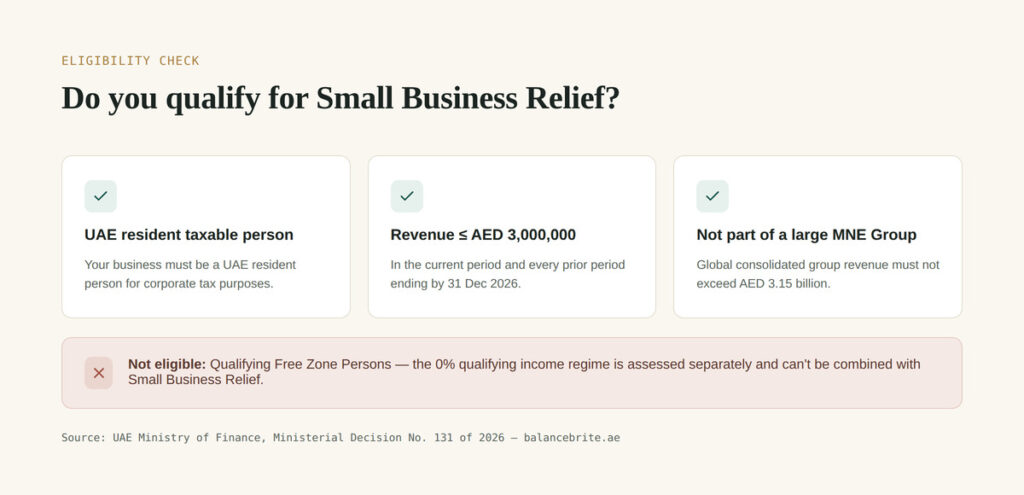
The relief was originally set to have a shorter runway. The Ministry of Finance has now extended it so that it applies to tax periods ending on or before 31 December 2029 — a three-year extension from where things previously stood. The revenue threshold itself hasn’t moved: it remains AED 3 million.
Who qualifies?
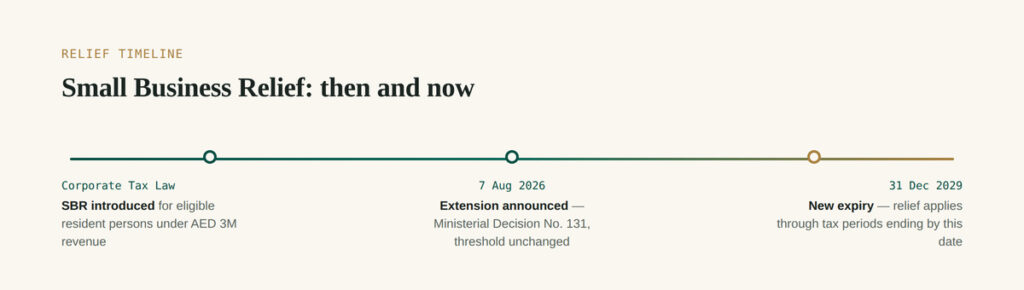
To elect into Small Business Relief, a business needs to meet all of the following:
- Be a UAE resident person for corporate tax purposes
- Have revenue not exceeding AED 3 million in the current tax period and in all previous tax periods (up to and including periods ending by 31 December 2026)
- Not be part of a Multinational Enterprise (MNE) Group with consolidated global revenue exceeding AED 3.15 billion
Who’s excluded
This is the part that catches free zone businesses off guard: Qualifying Free Zone Persons are not eligible for Small Business Relief. If your business is a free zone company benefiting from (or applying for) the 0% corporate tax rate on qualifying income, SBR isn’t an alternative path for you — the two regimes don’t stack, and you need to work out separately whether your free zone company actually meets the Qualifying Free Zone Person conditions.
It’s also worth noting that revenue, not profit, is the test. A business with thin margins but revenue just over AED 3 million doesn’t qualify, while a highly profitable business that stays under the threshold does.
Why this matters even though the news is “relief,” not a new tax
Three things are worth building into how you plan the next few years:
1. The relief is elective, not automatic. You have to actively elect into it when filing — it isn’t applied by default just because your revenue is under the threshold.
2. Growth can quietly disqualify you. Because the AED 3 million test looks at revenue across the current and prior periods, a strong growth year can retroactively affect your position. Businesses close to the threshold should be tracking revenue in real time, not finding out at filing time.
3. 2029 is a planning horizon, not a permanent exemption. Even with the extension, this is a temporary relief measure. Businesses that are growing steadily should be modelling what their tax position looks like once they exceed AED 3 million in revenue or the relief period ends — so the eventual move to standard corporate tax calculation isn’t a surprise.
What to do now
If you currently claim Small Business Relief, or you’re close to the AED 3 million threshold, it’s worth doing three things before your next filing:
- Confirm your eligibility for the current period — including checking prior-period revenue, not just the current year.
- Model your position without the relief — so you know roughly what a 9% corporate tax calculation would look like if your revenue crosses the threshold.
- Check your free zone status separately, if applicable — SBR and the free zone 0% regime are different tests with different paperwork.
The extension buys eligible small businesses real breathing room — through 2029 rather than a much nearer deadline — but it’s not a “set and forget” exemption. The businesses that get the most benefit from Small Business Relief are the ones actively tracking their revenue against the AED 3 million line and re-confirming eligibility every filing period, rather than assuming last year’s answer still holds.
If you’re not sure whether your business still qualifies, or what your position looks like if it doesn’t, Balance Brite’s corporate tax team can review your revenue history and confirm your election before your next filing deadline.
Balance Brite delivers reliable tax, VAT, corporate, and business advisory solutions to help businesses stay compliant, reduce risks, and grow with confidence.
Quick Links
Newsletter Signup
Subscribe for newsletter & get day news, service updates